Leila and I went to go to a movie yesterday, since we are in Seattle and we have free babysitting from Nana, Grandad, Anna, or Blake at any time. It has been nice. It is almost like dating again, except I am not sleeping out on the couch by myself. Now all four of us are sharing twin beds along the back of the pit. We can touch heads at night and all talk.
When I saw the opening credits and saw the distributor, Disney, I felt nervous and worried that somehow this would be so disneyfied like Pocahontas or something. For once, they left the beauty of the original story alone. The few modifications do not detract, nor do they change the spirit of the tale. In one case, with Edmund in prison meeting Mr. Tumnus as the witch informs Mr. Tumnus of Edmunds betrayal, it adds to the weight of his actions. Aslan and the rest are magical, but the special effects do not come at the cost of the story or meaning. The makers of this movie loved the books.
I think this is the best movie of the year. I hope everyone goes to see it so that they will make Prince Caspian, The Dawn Treader, and The Silver Chair while Edmund and Lucy are still young. The Horse and His Boy could be made later as well as The Magician's Aprentice.
C. S. Lewis had an insight into Christianity as well as children. That period in England after World War II was a magical time for literature. It is hard to believe that J.R.R. Tolkein and him worked and wrote together in England. Maybe the combination of the trials and horror of the war along with the depression and the hope of the recovery was necessary. I really would like to study some more to see the effect on other writers. I wonder if our tragedies are enough to inspire such art.
Friday, December 23, 2005


Tuesday, December 13, 2005

The life of Pi
I just finished this book.
The plot is odd in itself. The main character is travelling across the ocean with his family and the animals from their zoo, when the boat sinks. The boy, Pi Patel, is thrown into a life boat along with a hyena, a zebra, an orangatang, and a bengal tiger. The boat quickly sinks and they are left the only survivors. The zebra's leg was broken in the fall and is already injured. As the only prey in a boat full of predators he is quickly attacked by the hyena. The hyena kills the zebra slowly and then tries to attack the orangatang. The orangatang holds its own for a while, but as the days go on and on without rescue, the hyena overcomes it and consumes it. The hyena is then eaten by the tiger. Leaving Pi alone in the boat with a full grown tiger.
He manages to establish himself as dominant by providing food and blowing fiercely on his whistle while rocking the boat enough to induce sea sickness in the tiger. Like a lion tamer in the ring, he tames the tiger enough to survive 227 days on the raft until he runs into Mexico. Meanwhile they run into a blind frenchman in a similar life raft, both blinded by the sun and poor nutritien. They also find a carnivorous island inhabited by thousands of meerkats and a very complex algae.
The problem is that I don't believe it. I don't believe any of it, and I don't think that the character does either. There is another version of events told in the end, but how true is that account. What does it all mean? What is the island? What symbology is he pulling from and why include it? The story at the end explains everything, almost, except the island. Which makes me think that it is as fabricated. But why? Why start the book by explaining that this is a story to make you believe in God? If anything it shows how in the face of necessity even the most civilized, Pi Patel is an ideal vegetarian religious example, will become as feral as a tiger. But I think I am missing something. Any ideas?
The plot is odd in itself. The main character is travelling across the ocean with his family and the animals from their zoo, when the boat sinks. The boy, Pi Patel, is thrown into a life boat along with a hyena, a zebra, an orangatang, and a bengal tiger. The boat quickly sinks and they are left the only survivors. The zebra's leg was broken in the fall and is already injured. As the only prey in a boat full of predators he is quickly attacked by the hyena. The hyena kills the zebra slowly and then tries to attack the orangatang. The orangatang holds its own for a while, but as the days go on and on without rescue, the hyena overcomes it and consumes it. The hyena is then eaten by the tiger. Leaving Pi alone in the boat with a full grown tiger.
He manages to establish himself as dominant by providing food and blowing fiercely on his whistle while rocking the boat enough to induce sea sickness in the tiger. Like a lion tamer in the ring, he tames the tiger enough to survive 227 days on the raft until he runs into Mexico. Meanwhile they run into a blind frenchman in a similar life raft, both blinded by the sun and poor nutritien. They also find a carnivorous island inhabited by thousands of meerkats and a very complex algae.
The problem is that I don't believe it. I don't believe any of it, and I don't think that the character does either. There is another version of events told in the end, but how true is that account. What does it all mean? What is the island? What symbology is he pulling from and why include it? The story at the end explains everything, almost, except the island. Which makes me think that it is as fabricated. But why? Why start the book by explaining that this is a story to make you believe in God? If anything it shows how in the face of necessity even the most civilized, Pi Patel is an ideal vegetarian religious example, will become as feral as a tiger. But I think I am missing something. Any ideas?
Friday, December 02, 2005

Thursday, December 01, 2005


Wednesday, November 23, 2005
Aggie palm pilot
 AGGIE Palm Pilot.
 Aggies seem to care a lot about one thing. Beer. And bonfire, but some people died because, well, a huge tower of burning logs put together by Aggies . . . Not a good idea.

Dr. Borlaug is my hero
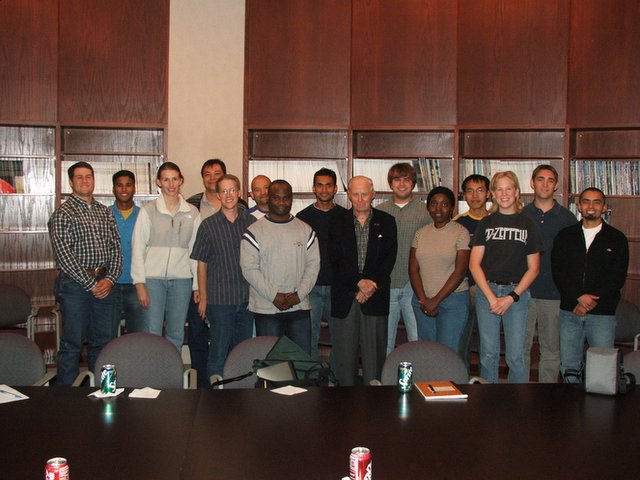 Dr. Borlaug met with some of us graduate students to discuss his history in plant breeding and international agriculture. He won the Nobel Peace Prize for the "Green Revolution". He personally has changed the world agriculture forever. From development of improved semidwarf wheat lines to trade and economic policies he made it possible for farmers in India, Pakistan, Mexico and others to have access to fertilizer, credit, and fair prices. That coupled with his disease resistant, high yielding lines drastically increased yields around the world.
I want to go back in time and be his graduate student!!!. If you have a time machine, let me know.
Aggie clock
My boss, Dr. Stelly, sent me this forward regarding an aggie clock. I can't resist putting it up.
Thursday, October 27, 2005
Wednesday, October 26, 2005
Sometimes professors just don't listen
I have had this idea to use quantile-quantile comparisons to analyze AFIS distribution data. AFIS is a machine that takes a cotton sample runs it through a wheel with little combs and separates the fibers. The individual fibers are blown into an airstream in a narrow tube. In the middle of the tube is an optical sensor that registers when a fiber passes, its length, and thickness. It can tell the difference between tangled and single fibers as well as trash. It then classifies the fibers into length, fineness, and maturity categories, while keeping count on trash and tangles, called neps. The distribution of fibers of different lengths makes a big difference on spinning quality. So people want to select for the best distribution of fibers, not just the best mean length or upper quartile length.
Quantiles divide the distribution into regular divisions like the median is the 50% quantile. The mean is not a quantile. It is not a rank. Anyway, the distribution, if continuous, can be divided into as many quantiles as one could want. A box plot is a representation of the 25% quantile, 50% quantile, and 75% quantile making the box. The whiskers are usually the 5% quantile and 95 or 97.5% quantile. The length values for the same quantiles for different distributions can be compared. If they are the same then the distributions are identical. If different the pattern of differences is how the distributions differ.
Anyway, to make a short story even longer and more boring, I went to a Statistics professor to talk about my idea. He thought it was great, but he never has actually got around to hearing how I want to do it. He has lectured me for two visits on the details of quantiles and distributions. Not that it hasn't been helpful, but he doesn't realize that I already know what he is trying to teach me.
I want to know if what he is calling a p-p plot, or a sample quantile-quantile graphical approach can be extended to more than one comparison kinda like covariance analysis. The y would be the quantiles of the check cultivar. The x's the quantiles of the experimental cultivar. The equation would be y = B1*[Year]*[X] + B2*[Replication]*[X] + B3*[Genotype]*[X] + [error variance], where [] notes matrix. The test would be to see if the slopes for genotype, replication, and years are equal, as well as the intercepts. If this is not right, then the other test I thought of would be to look at the deviations from x=y for each distribution. He did tell me about graphing the quantiles as y-x = x so that it is around 0 instead of a slope of 1, then the area under the curve can be calculated, deviations again. This number can be treated like a Wilcoxon type statistic. I just need to read up on Wilcoxon statistics I vaguely remember them in terms of nonparametric statistics.
I will put pictures up for the steps in the next few days.
Well if that isn't boring enough for you I don't know what is. I think with a few more posts like this I can cut my readership back to 0. I need to include a few references to swimsuits or hot chicks or cute girls or something in order to get someone to read the site. Statistics just isn't sexy enough.
Quantiles divide the distribution into regular divisions like the median is the 50% quantile. The mean is not a quantile. It is not a rank. Anyway, the distribution, if continuous, can be divided into as many quantiles as one could want. A box plot is a representation of the 25% quantile, 50% quantile, and 75% quantile making the box. The whiskers are usually the 5% quantile and 95 or 97.5% quantile. The length values for the same quantiles for different distributions can be compared. If they are the same then the distributions are identical. If different the pattern of differences is how the distributions differ.
Anyway, to make a short story even longer and more boring, I went to a Statistics professor to talk about my idea. He thought it was great, but he never has actually got around to hearing how I want to do it. He has lectured me for two visits on the details of quantiles and distributions. Not that it hasn't been helpful, but he doesn't realize that I already know what he is trying to teach me.
I want to know if what he is calling a p-p plot, or a sample quantile-quantile graphical approach can be extended to more than one comparison kinda like covariance analysis. The y would be the quantiles of the check cultivar. The x's the quantiles of the experimental cultivar. The equation would be y = B1*[Year]*[X] + B2*[Replication]*[X] + B3*[Genotype]*[X] + [error variance], where [] notes matrix. The test would be to see if the slopes for genotype, replication, and years are equal, as well as the intercepts. If this is not right, then the other test I thought of would be to look at the deviations from x=y for each distribution. He did tell me about graphing the quantiles as y-x = x so that it is around 0 instead of a slope of 1, then the area under the curve can be calculated, deviations again. This number can be treated like a Wilcoxon type statistic. I just need to read up on Wilcoxon statistics I vaguely remember them in terms of nonparametric statistics.
I will put pictures up for the steps in the next few days.
Well if that isn't boring enough for you I don't know what is. I think with a few more posts like this I can cut my readership back to 0. I need to include a few references to swimsuits or hot chicks or cute girls or something in order to get someone to read the site. Statistics just isn't sexy enough.
Monday, October 24, 2005
Thursday, October 20, 2005
Harvest is DONE, uh, well, kinda . . .
Ok we are not really done. We have 7 rows left and I haven't finished measuring heights or counting nodes. Augh.
The weather has been beautiful since our rain last week. The temperature is down to 90 and the mornings are a brisk 70 degrees. Nothing like Texas Fall weather. Employers really should interview candidates in Fall or Spring. Summer is just too oppressive here.
My field has three hawks that circle around waiting for us to scare vermin out of the brush. The other day one was sitting on the row ahead of us. The cotton plants were bent over under the weight and there was a rattling of bolls and breaking of limbs when he decided to take off.
Yesterday the cranes were out in the recently plowed field next door. The humingbirds are gone though and I haven't seen a monarch butterfly for a week. The black irridescent ones still hang around the morning glory vines. The vultures have stayed near the river or the road.
This year I haven't seen any snakes, lizards or turtles. Last year we had a large turtle that I took in the truck back to the pond near the lab. When I found it the turtle hissed at me, but did not run away or try to bite me. I put it in a box and drove back to lab. Just as I turned into the parking lot he managed to lunge out of the box and land in my lap. He tried to bite me as I was trying to turn the corner, so I batted at him and knocked him onto the floor, where he decided to hole up under the seat of the truck. I managed to get him out without getting bit and release him near the pond. He didn't seem grateful though. Kinda bitter if you ask me for a refugie turtle. I guess he didn't realize that the field was going to be plowed under.
The weather has been beautiful since our rain last week. The temperature is down to 90 and the mornings are a brisk 70 degrees. Nothing like Texas Fall weather. Employers really should interview candidates in Fall or Spring. Summer is just too oppressive here.
My field has three hawks that circle around waiting for us to scare vermin out of the brush. The other day one was sitting on the row ahead of us. The cotton plants were bent over under the weight and there was a rattling of bolls and breaking of limbs when he decided to take off.
Yesterday the cranes were out in the recently plowed field next door. The humingbirds are gone though and I haven't seen a monarch butterfly for a week. The black irridescent ones still hang around the morning glory vines. The vultures have stayed near the river or the road.
This year I haven't seen any snakes, lizards or turtles. Last year we had a large turtle that I took in the truck back to the pond near the lab. When I found it the turtle hissed at me, but did not run away or try to bite me. I put it in a box and drove back to lab. Just as I turned into the parking lot he managed to lunge out of the box and land in my lap. He tried to bite me as I was trying to turn the corner, so I batted at him and knocked him onto the floor, where he decided to hole up under the seat of the truck. I managed to get him out without getting bit and release him near the pond. He didn't seem grateful though. Kinda bitter if you ask me for a refugie turtle. I guess he didn't realize that the field was going to be plowed under.
Tuesday, October 18, 2005

Wednesday, October 12, 2005
Cotton harvest
Rita did not even come close to detroying us. It veered to the east on the last day and destroyed Beaumont and Port Arthur. But, now it is raining and my cotton is half picked and still in the field.
The problem is that with every rain the bolls hang lower and lower and then the cotton falls out onto the ground. The seeds absorb the moisture in the wet lint and then germinate. The little cotyledons in the boll die as soon as the sun dries everything out. The seeds die and the husks of seed coats get pulled through the gin and into the lint that I have to send in for testing. The fiber also gets weaker and weaker with rain and sun as well as accumulating dirt and trash from the wind and rain. All and all, not so good.
But, what can I do? I can't change the weather. If anyone knows how, please let me know, although with my luck it would have side effects and cause tornados instead of raining. Or worse stay insanely hot. Can you believe that it was over a 100 degrees just over a week ago?
We have a new student here in the lab, Stella from Greece. She is very nice. She is just discovering how difficult it is working here where no one is checking up on you or helping you to design good experiments.
I haven't written about Sheng Mei yet either. In part because this is a shared computer that I use and my blog is often up. I will change the settings so that a login is required after screen saver so that I can write about her. she is a different sort of person. To get to know her very well, one simply has to go to catforum, a sad site dedicated to people devoted entirely to cats. She posts on it 10-15 times a day and tells all the mundane, but strange parts of her life.
All I am going to say is that she tastes the cat food before she will give it to her 5 cats. So they only eat cat food that tastes good?
Anyway. I should not gossip.
Who knows. Maybe cat food is good. I should ask my little brother. We dared him to eat it when we were kids and he did. Maybe he liked it.
The problem is that with every rain the bolls hang lower and lower and then the cotton falls out onto the ground. The seeds absorb the moisture in the wet lint and then germinate. The little cotyledons in the boll die as soon as the sun dries everything out. The seeds die and the husks of seed coats get pulled through the gin and into the lint that I have to send in for testing. The fiber also gets weaker and weaker with rain and sun as well as accumulating dirt and trash from the wind and rain. All and all, not so good.
But, what can I do? I can't change the weather. If anyone knows how, please let me know, although with my luck it would have side effects and cause tornados instead of raining. Or worse stay insanely hot. Can you believe that it was over a 100 degrees just over a week ago?
We have a new student here in the lab, Stella from Greece. She is very nice. She is just discovering how difficult it is working here where no one is checking up on you or helping you to design good experiments.
I haven't written about Sheng Mei yet either. In part because this is a shared computer that I use and my blog is often up. I will change the settings so that a login is required after screen saver so that I can write about her. she is a different sort of person. To get to know her very well, one simply has to go to catforum, a sad site dedicated to people devoted entirely to cats. She posts on it 10-15 times a day and tells all the mundane, but strange parts of her life.
All I am going to say is that she tastes the cat food before she will give it to her 5 cats. So they only eat cat food that tastes good?
Anyway. I should not gossip.
Who knows. Maybe cat food is good. I should ask my little brother. We dared him to eat it when we were kids and he did. Maybe he liked it.
Wednesday, September 21, 2005

Monday, September 19, 2005
I am back
I haven't posted on this since june. I lost my internet connection and then the field and work ate up my time I usually spend killing time on the internet. I have a number of posts I need to upload:
1. Trip to Mexico.
2. Work update
3. Aleah and Emily pictures and update
4. Breeders tour
5. House repairs
6. SSRs etc.
Anyway. I am committed to taking work time for personal and blog related activities. Just kidding Dr. Stelly.
Really, I am kidding.
See you soon.
1. Trip to Mexico.
2. Work update
3. Aleah and Emily pictures and update
4. Breeders tour
5. House repairs
6. SSRs etc.
Anyway. I am committed to taking work time for personal and blog related activities. Just kidding Dr. Stelly.
Really, I am kidding.
See you soon.
Wednesday, June 22, 2005
Saturday, June 18, 2005
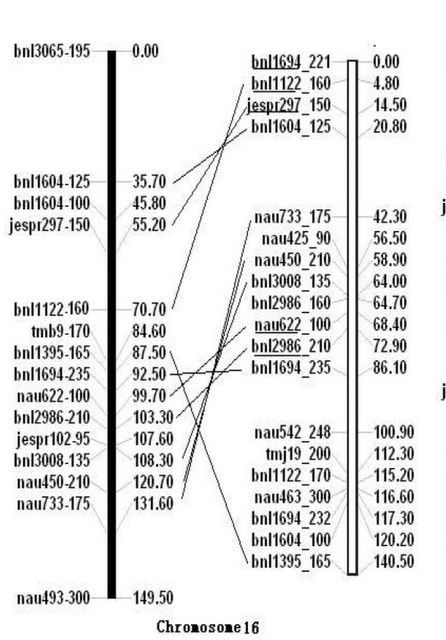
Song et al. Figure of the comparative map. The black linkage group is from BC1F1 the right is from haploid/doubled haploid. Note inversion of markers bsd1122, jspr297,bsd1604 and lower larger inversion. Interesting that there are three groups, almost like three separate linkage groups in haploid line.

Cotton mapping article
I am going to try and post an article a day that I have read and reviewed briefly here. Most will have to do with my work.
This article looked at two maps: BC1F1 TM-1(G. hirsutum) x [TM-1 x Hai7124 (G. barbadense)], and Vsg (G. barbadense) x [TM-1 x Hai7124]. Vsg is a virescent, a pale yellow-green, semigamous barbadense line. Semigamy is a mutation where the sperm and the egg nucleus do not fuse at fertilization and so depending on orientation of the spindles can produce progeny that are haploid, diploid, or with sectors of both. Haploids may be maternal or paternal. Sectors may be haploid or diploid. Diploid sectors are most vigorous and may overcome haploid regions.
The authors claim the maps are highly collinear. Discrepancies are noted as minor statistical errors or difficulty in ordering markers due to high number of double cross overs. I disagree with this claim. The differences are significant. I am posting an example linkage group. This may be due to using semigamous line or for comparing BC1s with different recurrent species. Was DNA extracted from whole plants? All lines tested in semigamous cross were haploid/doubled. How many were truly doubled? How many paternal/maternal haploids were produced? Maternal haploids would have no linkage information. Only paternally derived haploids would be beneficial since F1 was paternal. Were they chimaeric?
Maybe we should all do like in the Quadmap paper and bootstrap each linkage group to get a sense of how reliable the associations are.
Xianliang Song, Kai Wang, Wangzhen Guo, Jun Zhang, and Tianzhen Zhang. 2005. A comparison of genetic maps constructed from haploid and BC1 mapping populations from the same crossing between Gossypium hirsutum L. and Gossypium barbadense L. Genome 48: 378–390
This article looked at two maps: BC1F1 TM-1(G. hirsutum) x [TM-1 x Hai7124 (G. barbadense)], and Vsg (G. barbadense) x [TM-1 x Hai7124]. Vsg is a virescent, a pale yellow-green, semigamous barbadense line. Semigamy is a mutation where the sperm and the egg nucleus do not fuse at fertilization and so depending on orientation of the spindles can produce progeny that are haploid, diploid, or with sectors of both. Haploids may be maternal or paternal. Sectors may be haploid or diploid. Diploid sectors are most vigorous and may overcome haploid regions.
The authors claim the maps are highly collinear. Discrepancies are noted as minor statistical errors or difficulty in ordering markers due to high number of double cross overs. I disagree with this claim. The differences are significant. I am posting an example linkage group. This may be due to using semigamous line or for comparing BC1s with different recurrent species. Was DNA extracted from whole plants? All lines tested in semigamous cross were haploid/doubled. How many were truly doubled? How many paternal/maternal haploids were produced? Maternal haploids would have no linkage information. Only paternally derived haploids would be beneficial since F1 was paternal. Were they chimaeric?
Maybe we should all do like in the Quadmap paper and bootstrap each linkage group to get a sense of how reliable the associations are.
Xianliang Song, Kai Wang, Wangzhen Guo, Jun Zhang, and Tianzhen Zhang. 2005. A comparison of genetic maps constructed from haploid and BC1 mapping populations from the same crossing between Gossypium hirsutum L. and Gossypium barbadense L. Genome 48: 378–390
Subscribe to:
Posts (Atom)